What falls through the gaps: notes on regenerative climate action
It was just after six in the morning and I was standing on the muddy channel between Walney Island and Barrow-in-Furness town, crowded, with a handful of others, around our guide's outstretched hand. In it, a juvenile spider crab, about the size of a 50 pence piece. Behind us, just a few hundred metres away, the hulking sheds of the Devonshire Dock Hall, part of the BAE Systems shipyard that dominates the town.
I was there with Art Gene, a local art collective running a project called Extreme Views, where residents, artists and ecologists spent time with the many sides of the town.
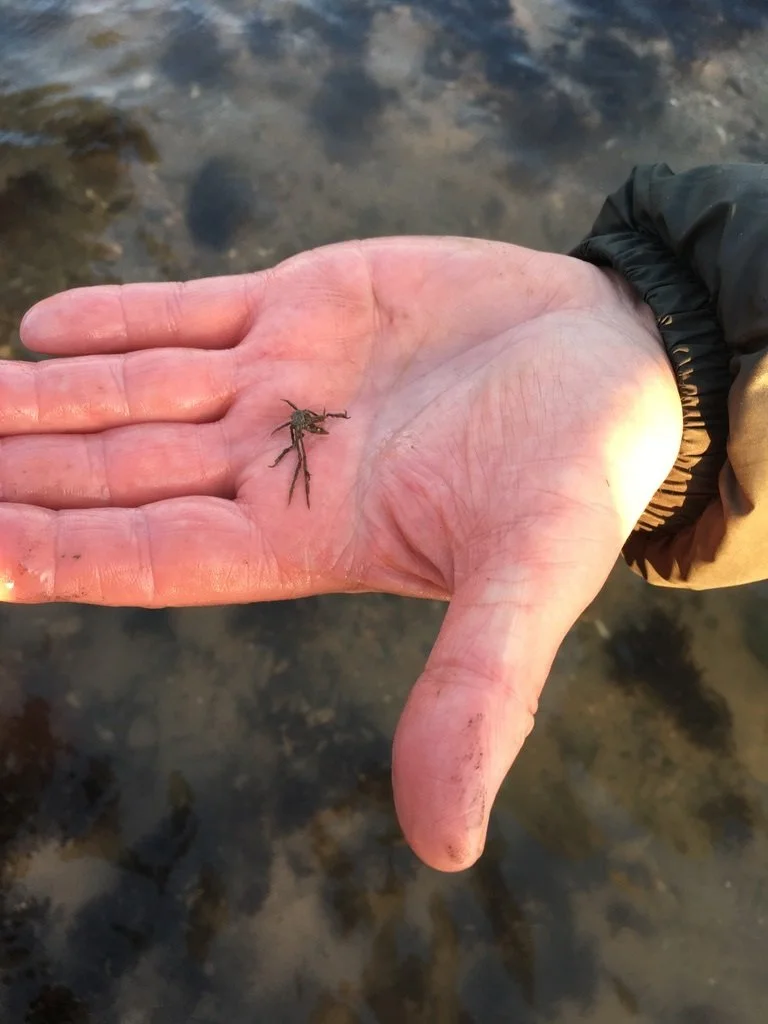
That morning at low tide remains to me one of my clearest experiences of how much falls through the gaps when we work on climate, or on poverty, or biodiversity, or any other single issue. It brought to life for me the importance of thinking in relationships, in rooting work in place and in context and in seeing potential and not only problems. And of course, the difficulty in doing all of those things even when one is committed to working for systemic change.
This experience was part of what brought me to valuing regenerative ways of working. Approaches rooted in a place's many dimensions, working with them rather than around them. I'm now lucky enough to be exploring this at Subak as we look at what this means for how we approach climate work: a field where single measures like carbon are both essential metrics and issues which can crowd out others.
A few weeks ago, as part of this, we brought together a small group of people and organisations who've inspired us in how they apply regenerative approaches in their work, but who haven't previously been significantly involved with Subak, marking the beginning of us thinking more out loud about what a regenerative approach to climate actually means.
Between them, the group's experience spanned agriculture, design, innovation, business and policy, different vantage points, but a shared interest in how regenerative approaches can actually build momentum.
Here are a few things that stayed with me from the conversation:
Regeneration is a buzzword, but does it require more definition or just more practical examples?
More than one person pointed out that the wave of regenerative language we saw several years ago from many organisations hasn't necessarily led to a deepening of real-world application. Some put this down to there needing to be better definitions in place, both to prevent unsubstantiated claims and to enable market conditions to develop to fit innovators who are doing things differently and struggle to fit into current frameworks and categories. Others pushed back against the "definition trap," advocating instead for more examples which show in practice what this kind of work can look like, so that people can experience it, in the many ways it could show up in our communities.
Are rules and incentives the best point for change, or is this political, about power and voice?
People kept coming back to a harder question about what will open up an opportunity for this kind of work: is it markets and institutions with their rules and incentives that shape how capital and regulation behave, or is it fundamentally political, about power, organising, and who has a say? Is working on the former without actively engaging in the latter ever sufficient?
Those doing this well are hacking the system, and it's unsustainable.
Again and again, the examples people shared were about work-arounds. People and organisations are finding ways to make their work both valid and viable, because the systems around them weren't built to hold it. That experience of "hitting the wall" is exhausting for those involved, and it means small wins aren't adding up to systemic change.
Extreme Views: top down, or rooted in place?
The discussion danced between two perspectives: the need for global, legible action on climate, the kind that lets nations and institutions move forward together, on issues with real tension and real stakes, and the need for local, rooted, interconnected action that works with the true complexity and messiness of life. Where climate is about how hot our homes feel, what food we can buy, how healthy our loved ones are. Neither of these "extreme views" can win out; we need them both. But we recognised how hard they are to reconcile, and that not enough is being done in the transition space where they meet.
A few people, as the day closed, brought us back to who wasn't in the room. A critical question that has stayed with me since.
It reminded me of my morning in Barrow. As human beings we constantly navigate complexity that is seemingly impossible; the spider crab, the BAE shed, the headlines about poverty and deprivation, the beauty of the landscape, the creativeness of the community. But when it comes to our organisations, our institutions, our decision-making and political domain, we struggle to know how to work with that complexity, and need to find ways which don't let things fall through the gaps.
What’s next?
We’ll be sharing more about our exploration of regenerative approaches to climate action. Get in touch if you’d like to talk or be part of future gatherings.
With thanks to the following people for sharing their time and perspectives:
Rowan Conway, Roberta Eardland, Delfina Fantini van Ditmar, Louise Kjellerup Roper, Alex Parker, Sue Pritchard, Kyle Soo, Kat Zscharnagk